Sharing the road with semi-trucks is part of everyday driving in Indiana. These vehicles are taller and longer than passenger cars, which creates larger areas where a truck driver’s vision is limited. Many people ask, How can you tell if the driver of a large truck can see you? The answer is straightforward: a truck driver can generally see you when you are visible in the side mirrors, and you can spot the driver’s face. If the driver’s face is missing from the mirrors, your vehicle is most likely sitting in a blind spot, often called the “no zone.” To remain visible, give the truck space and avoid staying in these blind spots, which cover the front, rear, and sides of the vehicle.
At Blackburn Romey, we understand how visibility mistakes in truck collisions can change lives in an instant, and we are here to guide families through the challenges that follow.
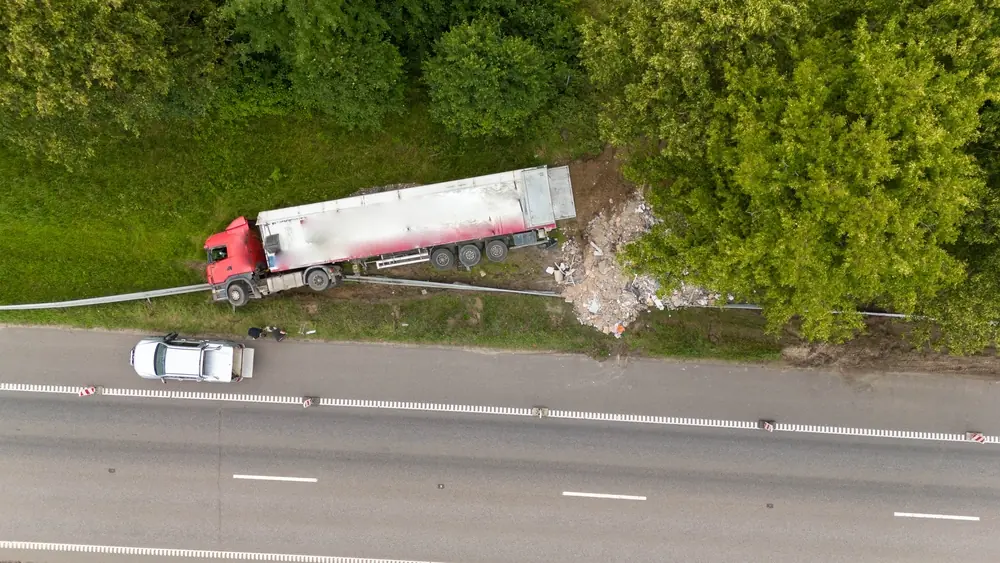
According to the Federal Motor Carrier Safety Administration (FMCSA), large trucks and buses, also referred to as commercial motor vehicles (CMVs), have significant operating limitations, including large blind spots, long stopping distances, and reduced maneuverability, which makes it essential for nearby drivers to prioritize safety.
Blind spots are the areas around a truck where the driver cannot see you directly, even with mirrors. They exist on all four sides of a tractor-trailer and change with speed, lighting, road grade, and weather. A compact car, a motorcycle, or a low sports sedan can disappear in these areas, which raises the risk during lane changes and wide turns.
As noted by the Indiana Department of Transportation (INDOT), drivers should avoid the “No Zone,” the large blind spot on a truck’s passenger side where the truck operator cannot see other vehicles.
The front no-zone begins just ahead of the cab, the rear extends behind the trailer, and the driver’s side area sits close to the cab. These distances change with hills, curves, or heavy loads, and bad weather or night driving can make the danger zones larger, so give yourself extra room in poor conditions.
How can you tell if the driver of a large truck can see you? The fastest check is the mirror test: look for the driver’s face in the side mirror. If you cannot see it, the driver may not see you. Other indicators appear in real time:
Many people also wonder about visibility while merging or exiting. Watch how the truck responds: if the driver eases off the accelerator to make space, they have likely noticed you; if the speed stays steady and the trailer continues on its line toward you, it is safer to assume you are unseen and adjust.
Contact a Car Accident Lawyer Near You
Safe driving habits reduce your risk on the road. When you prepare to pass a truck, pause and consider whether the driver can see you. A good rule is to check the side mirror and confirm you can spot the driver’s face. If you can, move past with clear, deliberate actions:
These steps reduce the chance of a Truck Accident and help you document that you drove carefully if a dispute arises later.
Understanding how to file a truck accident lawsuit in Indiana in 2025 is just as important as knowing how to stay safe on the road. If a collision occurs, the process typically begins with filing a personal injury claim, preserving evidence such as photos, medical records, and police reports, and consulting an experienced attorney who can guide you through Indiana’s filing deadlines and legal requirements.
Collisions tied to blind spots often cause significant harm because of the weight difference between a tractor-trailer and a car. Immediate, organized action protects your health and your claim:
Document visibility details, too. Ask yourself, how can you tell if the driver of a large truck can see you? Note whether you saw the side mirror, whether the driver appeared to check mirrors, and where your vehicle sat relative to the trailer. Small facts like turn-signal timing or whether you could see the driver’s face often matter later.
Calling a truck accident lawyer in Indiana is always important and especially so when a crash involves questions of visibility, blind spots, or driver negligence. Legal guidance can help explain how responsibility may be evaluated between drivers, clarify filing deadlines, the types of evidence that may be useful, and the way insurance companies approach blind spot cases.
At Blackburn Romey, our team is ready to review your situation and walk you through the options available under Indiana law. Many drivers still ask, How can you tell if the driver of a large truck can see you? When is legal support necessary after a truck accident? We are here to provide that guidance. Contact us today at 833-FOR-HELP for a free consultation.
Blackburn Romey founding partner Tom Blackburn graduated with honors receiving a degree from Indiana University at the Robert H. McKinney School of Law. Initiating his legal career in 1977, he has been active in practicing law and currently serves as a member of the Indiana State Bar Association on the Ethics and Advertising Committees, the American Bar Association, the American Association for Justice, as a board member at the Indiana Trial Lawyers Association, and as an appointed member of the Executive Committee for the State of Indiana for the National Trial Lawyers Association.

This page has been written, edited, and reviewed by a team of legal writers following our comprehensive editorial guidelines. This page was approved by Founding Partner, Tom Blackburn, who has more than 47 years of legal experience, including over 39 years specializing as a personal injury attorney.

