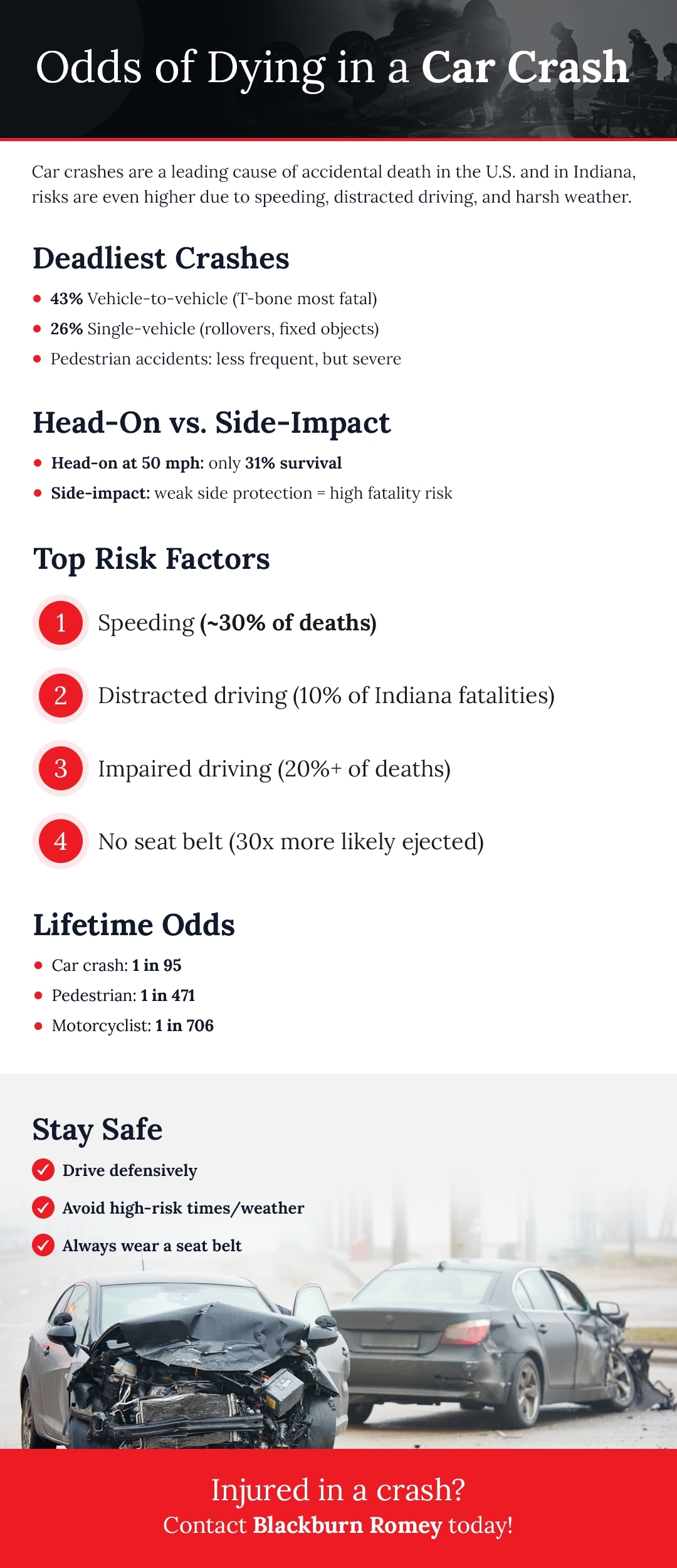
Lifetime odds of dying in a U.S. car crash are about 1 in 95.
Vehicle-to-vehicle collisions caused 43% of traffic deaths in 2022.
Single-vehicle crashes caused about 26% of motor vehicle fatalities.
About 77% of U.S. drivers experience at least one crash in their lifetime.
Indiana allows families to file wrongful death claims after fatal crashes.
Car accidents are one of the most common causes of accidental death in the U.S., and for Indiana drivers, the risks are more serious than many realize. So, what are the odds of dying in a car crash? The answer goes beyond numbers. It depends on how, when, and where you drive, as well as the behavior of others on the road.
Despite improvements in automobile safety, speeding, texting and driving, and inclement weather still cause thousands of deaths annually. At Blackburn Romey, it is all about comprehending these dangers and how to prevent them to keep yourself and your loved ones safe. In this guide, we’ll break down the latest fatal crash data, explore the most dangerous collisions, and offer proactive strategies to reduce your risk whenever you’re behind the wheel.
According to data from the National Safety Council, collisions between vehicles were a major cause of motor vehicle-related deaths in 2024, accounting for 43% of all fatalities. Collisions between a motor vehicle and a fixed object were the next most common type, with over 26% of deaths, followed by pedestrian incidents and non-collisions (rollovers, etc.). While collisions between motor vehicles accounted for less than half of motor-vehicle fatalities, this crash type represented 79% of injuries, 74% of injury crashes, and 71% of all incidents.
Conversely, single-vehicle crashes involving collisions with fixed objects, pedestrians, and non-collisions accounted for a greater proportion of fatalities and fatal crashes compared to less serious crashes. These three crash types made up 53% of fatalities and 55% of fatal crashes, but only 25% or less of injuries, injury crashes, or all crashes.
Fatal speed-related collisions accounted for 24% of fatal collisions
Distracted driving collisions, collisions involving disregarding a traffic signal, aggressive driving collisions, and alcohol-impaired collisions each made up 5% or fewer of total collisions.
Hit-and-run collisions made up 13% of all crashes
What Types of Collisions Are the Most Deadly?
According to data from the National Safety Council, collisions between vehicles were a major cause of motor vehicle-related deaths in 2022, accounting for 43% of all fatalities. Within this category, angle collisions, such as side-impact or T-bone crashes, were identified as the deadliest due to their significant impact force and the vulnerability of vehicles at these angles.
Single-vehicle crashes involving incidents like hitting fixed objects (e.g., trees, poles) or rollovers contributed to approximately 26% of motor vehicle fatalities. These types of crashes often occur due to loss of control, speeding, or impaired driving.
Although less frequent, pedestrian crashes remain a substantial factor, demonstrating the ongoing risk to individuals outside vehicles. These incidents highlight the need for improved infrastructure, driver awareness, and pedestrian safety measures to reduce preventable deaths.
Head-On vs. Side-Impact Crashes
Head-on collisions are often among the most tragic types of car accidents. These accidents typically occur at high speeds, especially on undivided highways, where vehicles traveling in opposite directions collide with extreme force. The sheer impact can lead to catastrophic damage to cars and devastating injuries for those involved. Survivors of head-on collisions frequently endure life-altering injuries such as traumatic brain injuries, spinal cord damage, or multiple fractures. Unfortunately, fatalities in such crashes remain alarmingly high due to the intense energy transferred during the collisions.
On the other hand, side-impact crashes, commonly known as “T-bone” collisions, occur when one vehicle strikes the side of another. These accidents are hazardous because the sides of most vehicles offer far less structural protection than the front or rear. With minimal space between the vehicle’s side and its occupants, passengers are highly vulnerable to severe injuries, including internal organ damage, broken bones, and head trauma. In many cases, side-impact crashes can result in fatalities, mainly if the collision occurs at high speed or involves a larger vehicle like a truck or SUV.
Why Speed Plays a Critical Role
Speed plays a crucial role in both the likelihood and severity of crashes. The faster you drive, the less time you have to react to unexpected events, and the more significant the impact during a collision. Doubling your speed doesn’t just double the force in a crash—it quadruples it. At such high forces, the chances of survival rapidly decrease, especially beyond certain speeds. For example, data consistently shows that accidents over 50mph drastically reduce survival rates. This is particularly alarming in crashes involving vulnerable road users like pedestrians or cyclists with little to no protection. Higher speeds also increase the stopping distance, making it even harder to avoid collisions. This highlights why speed limits are a key factor in road safety, designed to protect drivers and others sharing the road.
Car Crash Survival Rates by Speed
The car crash survival rate falls sharply as impact speed increases, because crash energy climbs much faster than speed itself. According to theInsurance Institute for Highway Safety, when impact speed increases from 40 to 60 mph, a 50 percent jump, the energy a vehicle must absorb rises by 125 percent. Many Indiana rural highways and interstate corridors already post speeds in that range, which means even modest speeding pushes crash energy higher fast.
That danger has been confirmed directly through real-world testing. A jointIIHS and AAA Foundation crash test study compared identical vehicles struck at 40, 50, and 56 mph, and found that the higher-speed impacts produced significantly more structural damage and greater force on the test occupant, even though every vehicle carried the same safety features. The results showed that speed increases many drivers would consider modest can overwhelm the same protections that work well at lower speeds, which is exactly why the car crash survival rate drops off so quickly once impact speed climbs past a certain point.
Why Survival Odds Decrease as Impact Speeds Increase
Vehicle structure, seat belts, and airbags are built to manage crash forces only up to a certain point. Once impact speed pushes energy past what the vehicle can handle, protection drops off quickly rather than gradually.
A relatively small increase in speed can separate a survivable crash from a fatal one, which is the core reason the car crash survival rate falls off so steeply once speeds climb past that threshold.
How Modern Vehicle Safety Features Affect Survival Rates
Vehicle safety technology has meaningfully improved survival odds at moderate speeds. Advanced airbag systems, reinforced side-impact structures, and electronic stability control, which helps a driver keep control during a sudden swerve, reduce injury severity in many Indiana crashes that would have been fatal a generation ago.
Automatic emergency braking and forward collision warning systems help some drivers avoid a high-speed impact altogether. None of this technology changes the underlying physics, though. Once impact speeds move well beyond what posted speed limits allow, the car crash survival rate still declines steeply.
How to Reduce Your Chances of Dying in a Car Accident
Understanding the risks of car accidents is one thing. But what measures can you take to reduce the chance of becoming a statistic? You may be surprised to learn that the most effective strategies don’t always involve advanced safety features but simple, actionable practices.
Defensive Driving Techniques That Save Lives
Defensive driving is one of the most effective techniques for reducing the risk of accidents and ensuring safety on the road. It involves adopting proactive habits like maintaining a safe distance between vehicles, carefully obeying traffic signals, and staying calm to prevent road rage. By cultivating these practices, drivers can significantly increase their chances of avoiding collisions and keeping everyone safe.
According to INDOT, defensive driving also means being mindful of aggressive drivers by steering clear of their behavior, avoiding retaliatory gestures, and yielding the right of way when needed to de-escalate tense situations. This approach reduces risks and promotes a safer and more cooperative driving environment.
Key strategies for defensive driving include:
Regularly scanning your surroundings by checking mirrors to stay aware of nearby vehicles and potential hazards.
Anticipating the actions of other drivers, particularly in congested or unpredictable traffic conditions, is crucial to react quickly and effectively.
Keeping a safe following distance, especially during poor weather, heavy traffic, or low visibility, gives you ample time to respond to sudden changes.
Defensive driving empowers individuals to navigate the roads and minimize accidents confidently by combining awareness, preparation, and patience.
When to Avoid the Road: High-Risk Times and Conditions
Specific times and conditions significantly increase crash risks. Night hours, particularly on weekends, see heightened incidents due to the prevalence of fatigued or intoxicated drivers. Similarly, holidays like New Year’s Eve and the Fourth of July present unique risks as celebrations often overlap with impaired driving.
Adverse weather also spikes crash statistics in Indiana. Rain, snow, or icy roads demand slower speeds and heightened caution as they reduce traction and visibility. Staying informed about weather forecasts and being strategic about travel times can go a long way in avoiding unnecessary risks.
What Are the Lifetime Odds of Dying in a Car Accident?
The chances of dying in a car crash vary based on factors like your age and driving experience, your habits such as speeding, distracted or impaired driving, and external conditions such as weather, road type, and whether you use seat belts.
According to the most recent statistics, the National Safety Council (NSC) estimated that the lifetime odds of an American dying in a car crash are approximately 1 in 101 over one’s lifetime.
This risk is comparable to that of dying from a fall (1 in 89) and remains higher than many other accidental causes of death.
Below are different causes of fatality along with their associated lifetime odds, including car crashes for reference:
Motor-vehicle crash: Lifetime odds 1 in 101
Pedestrian incident: Lifetime odds 1 in 492
Motorcyclist: Lifetime odds 1 in 726
Bicyclist: Lifetime odds 1 in 3,093
While car crashes remain a leading cause of accidental deaths, some risks are significantly lower. For example, the lifetime odds of a motorcyclist dying in a crash are 1 in 726, and fatalities from dog attacks are even rarer, with odds of 1 in 1 in 33,899. The risk for bicyclists (pedalcyclists) stands at 1 in 3,093. These figures emphasize the importance of responsible driving practices, pedestrian awareness, and road safety measures to reduce the likelihood of tragic accidents.
What Are The Chances Of Getting Injured In A Car Crash?
For every 100 million miles driven, about 74 people were injured in crashes, according to the National Highway Traffic Safety Administration (NHTSA). In 2024, an estimated 2.42 million people were injured on U.S. roads, a 0.8% decrease from 2.44 million in 2023.
The injury rate per 100 million vehicle miles traveled (VMT) also dropped, falling from 75 in 2023 to 74 in 2024.
What Are the Odds of Being in a Car Accident in Your Lifetime?
The most recent information indicates that about 77% of drivers in the U.S. have experienced at least one accident during their driving years. On average, a driver must also file an insurance claim for a car accident roughly once every 18 years. This means they might get into a collision about three to four times throughout their life.
There are several factors that can influence these odds:
Age: Younger and less experienced drivers have higher accident rates compared to aged drivers. Usually, drivers over 70 mostly get involved in non-fatal and non-injury accidents.
Driving habits: Certain driving habits increase the risk of accidents. These include speeding, distracted driving, driving under the influence, tailgating and weaving in and out of traffic.
Location: Busy urban areas with heavy traffic congestion may see increased cases of accidents due to increased interactions between vehicles and pedestrians. On the other hand, rural areas tend to register fewer accidents.
Environmental factors: Rain, snow, ice, or fog can reduce visibility and traction, increasing the likelihood of accidents.
What Is the Survival Rate for Head-On Collisions?
In head-on collisions, the survival rate depends largely on the speed at which the vehicles are traveling. At slower speeds, the survival rate is relatively high, with around 99% of individuals surviving such accidents with only minor injuries.
However, at 50 mph, the survival rate drops to about 31%. This means roughly one-third of individuals involved in head-on collisions at this speed will not survive.
When it comes to speeds of 70 mph or higher, the survival rate is extremely low and fatalities are almost guaranteed.
Factors That Increase Your Odds of a Fatal Car Crash
Seasonal trends also play a role. For example, Autumn Car Crash Causes: What Drivers Should Know often include reduced daylight hours, wet leaves on roadways, sudden temperature drops, and increased wildlife activity, all of which can significantly raise the risk of serious collisions.
While anyone can be involved in a car accident, certain behaviors, conditions, and environmental factors significantly raise the likelihood of a crash resulting in death. Some of those causes are:
#1. Speeding
This increases both the severity of impact and the likelihood of losing control of your vehicle. Nationally, speeding is responsible for nearly 29% of all traffic fatalities. Indiana drivers face additional risks during winter when icy roadways exacerbate the dangers of driving too fast for conditions.
#2. Distracted Driving
It is a growing problem, especially with the prevalence of smartphones. In Indiana, distracted driving was a factor in over 10% of fatal crashes last year, highlighting the dangers of texting, eating, or adjusting in-car technology while driving.
#3. Impaired Driving
Drunk driving and drugged driving remain significant contributors to fatal car crashes. In the state, over 20% of all traffic fatalities in recent years involved alcohol-impaired drivers. Even small amounts of alcohol can impair reaction time and decision-making.
#4. Failure to Use Seat Belts
Seat belts are one of the simplest and most effective ways to reduce the likelihood of dying in a crash. Based on the NHTSA, individuals not wearing seat belts are 30 times more likely to be ejected from a vehicle in a collision, a scenario that often proves fatal.
#5. Rural Roads
Indiana’s rural roads present unique risks. With fewer safety barriers, limited lighting, and less traffic enforcement, rural road crashes tend to be more severe than those occurring in urban areas.
What Happens After Someone Dies in a Car Accident in Indiana?
When a person dies in a car collision, several legal and administrative processes begin. First, law enforcement and emergency services respond to the scene to investigate the cause of the crash and determine whether negligence or illegal activity (e.g., drunk driving) played a role. A death certificate will then be issued, and surviving family members may need to manage both funeral arrangements and the deceased’s estate.
In fatal car accidents caused by negligence, the victim’s family may be entitled to file a wrongful death claim to recover financial damages. Legal actions may include pursuing an insurance claim, a civil lawsuit, or both.
If someone dies in a car crash caused by another person’s negligence, their family has several legal options to pursue justice and compensation. These options generally focus on holding the at-fault party accountable for the wrongful death and recovering damages for the loss.
Filing an Insurance Claim on Behalf of Someone Who Has Died in an Accident
After a fatal car incident, the deceased’s family can often file a claim with the at-fault driver’s insurance company. This process involves:
Filing a Claim: Submit documentation of the accident, the victim’s death, and associated costs (e.g., medical bills, funeral expenses).
Negotiating with the Insurer: Insurance companies often attempt to minimize payouts, so having an experienced attorney can help you advocate for fair compensation.
Seeking Compensation: This may include damages for medical expenses, lost wages, and emotional distress.
Indiana is a fault-based insurance state, which means the insurance of the at-fault driver is responsible for compensating the victim’s family.
Bringing a Wrongful Death Lawsuit Against the Person Who Caused the Accident
In cases where an insurance settlement is insufficient, families may file a wrongful death lawsuit against the at-fault driver. This civil lawsuit seeks to hold the negligent party accountable and recover damages for the financial and emotional losses caused by the victim’s death.
Damages awarded in wrongful death cases may include:
Medical expenses incurred before the victim’s death.
Funeral and burial costs.
Loss of income and financial support.
Emotional suffering and loss of companionship.
What Are the Odds of Getting Hit by a Car While Walking?
According to the Centers for Disease Control, over 8,000 pedestrians were killed on our nation’s roads in crashes involving a motor vehicle in 2022. That’s about one death every 64 minutes. One in five people who died in crashes in 2022 was a pedestrian.
Injured in a Car Accident? Contact Our Attorneys Today
To reduce your odds of dying in a car crash, it is important to understand and mitigate the risk factors. Unfortunately, you cannot possibly prevent all accidents. If you need help after a car accident, be sure to get the legal assistance you need to pursue fair compensation for your injuries.
Blackburn Romey founding partner Tom Blackburn graduated with honors receiving a degree from Indiana University at the Robert H. McKinney School of Law. Initiating his legal career in 1977, he has been active in practicing law and currently serves as a member of the Indiana State Bar Association on the Ethics and Advertising Committees, the American Bar Association, the American Association for Justice, as a board member at the Indiana Trial Lawyers Association, and as an appointed member of the Executive Committee for the State of Indiana for the National Trial Lawyers Association.
This page has been written, edited, and reviewed by a team of legal writers following our comprehensive editorial guidelines. This page was approved by Founding Partner, Tom Blackburn, who has more than 47 years of legal experience, including over 39 years specializing as a personal injury attorney.